
My Cart



Long Range Two Way Radios
Walkie-talkie range depends on whether a licence is required, the frequency bands on which the device operates, and the operating environment. Not sure what long range two way radios are? Keep reading to find out exactly what they are and how they differ from other models.
Not sure what you need?
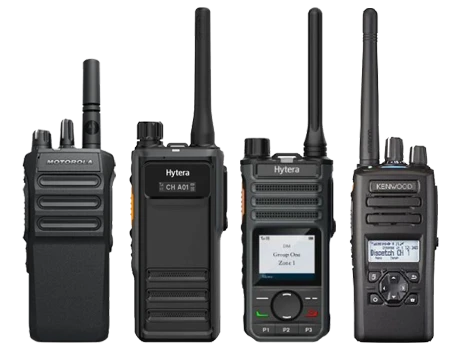
Are 50 km walkie-talkies a reality?
Long-range walkie-talkies are designed to cover significantly greater distances than standard models. A PMR446 two way radio can reach up to 5-6 km in ideal conditions. But the question is: are there licensed professional models that can exceed 30 km or 50 km in open spaces? As mentioned, it all depends on several factors. These figures are estimates in optimal conditions, which are not always achieved in real professional scenarios. A licensed 2 way radio typically has a range of 8-12 km.
Licensed vs licence-free walkie-talkies
Walkie-talkie rang can vary depending on the type of device, including the frequencies used, the transmission power, and whether the walkie-talkie requires a licence or not.

PMR446 walkie-talkies (licence-free)

(Personal Mobile Radio, 446 MHz) is an open radio band for licence-free walkie-talkies. In urban areas with many obstacles, range varies between 1-6 km.
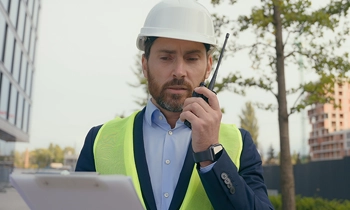
Licensed professional radios (UHF/VHF)
UHF (Ultra High Frequency) is ideal for use in urban areas and inside buildings, covering the frequency range from 300 MHz to 3 GHz.
VHF (Very High Frequency) is particularly effective in open spaces without many obstacles, and VHF signals have longer wavelengths.
What to consider with long range two way radios
Professional, licensed models (UHF/VHF) can transmit at much higher power levels (4-5 W or more) and offer greater range, but they require officially assigned frequencies. These devices typically achieve between 8 and 12 km in optimal conditions. That’s what you’ll usually see in “long range” equipment rankings.

Keep in mind
- Transmission power: licensed walkie-talkies can reach up to 4-5 W (and more when used with repeater systems), while licence-free two way radios (PMR446) are limited to a maximum of 0.5 W, even with a very long antenna, it is important to mention that there is no possibility of adding repeaters or antennas.
- VHF performs better in open spaces (countryside) but struggles with obstacles.
- UHF penetrates urban environments better, although its open-field range is usually shorter.
- Obstacles and weather: buildings, vegetation, hills or atmospheric conditions can drastically reduce real world range.
But… what about licence-free two way radios?
ANALOGUE PMR446
Range - Up to 5-8 km in open terrain; less in cities.
Audio quality - Good in open spaces, but loses clarity with noise, interference or distance.
Privacy - Limited (anyone with a walkie-talkie on the same frequency can listen).
Number of users - One transmission per channel.
Battery life - Lower energy efficiency; batteries drain faster.
Price - More affordable.
Robustness / ranges - Very common in entry level and mid-range models.
Typical uses - Hikes, leisure, schools, occasional or semi-professional use.
Digital PMR446 (dPMR / DMR446)
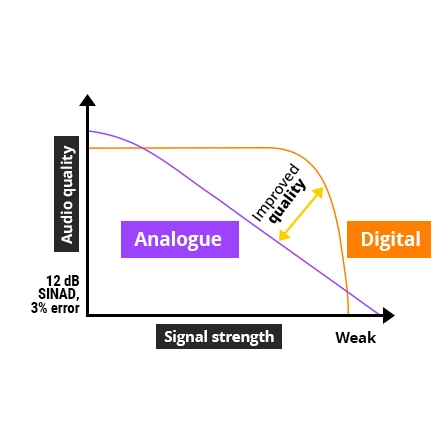
Range - Same as analogue (5-8 km) but in practice the digital signal stays clearer over longer distances and with obstacles.
Audio quality - Cleaner, more consistent audio, even in noisy or interference-prone environments.
Privacy - Better privacy (basic encryption and digital coding).
Number of users - Allows more simultaneous users on the same channel thanks to digital “slots” (TDMA).
Battery life - More efficient: batteries generally last longer.
Price - More expensive, as it’s a more advanced technology.
Robustness / ranges - More common in professional long range models.
Typical uses - Security, logistics, hospitality, large sites, demanding environments.

Conclusion
| Type of walkie-talkie | Real world range | Theoretical range |
| Professional walkie-talkie (VHF/UHF) | 8-12 km (outdoors) | Up to 50 km (ideal conditions) |
| PMR446 (licence-free) | 1-6 km (max. 0.5 W) | Up to 30+ km (ideal conditions) |
Our selection of long range two way radios (licence-free)
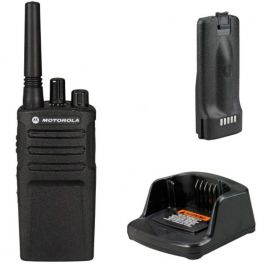
Ref: MOXT420
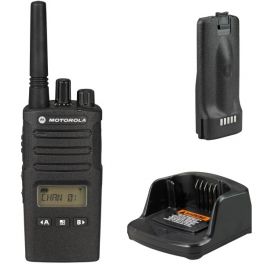
Ref: MOXT460
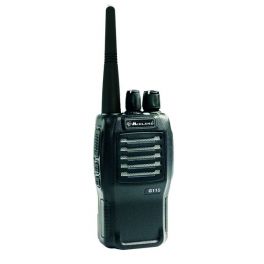
Ref: MIG11PRO
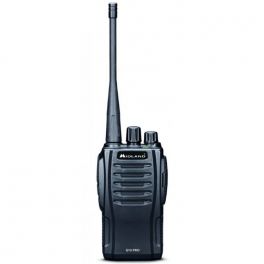
Ref: MIG10PRO
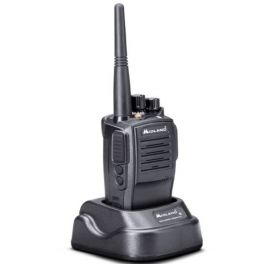
Ref: MIG15PRO
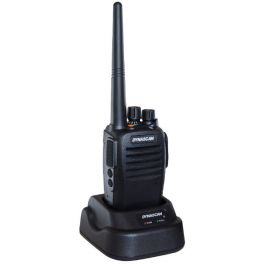
Ref: DYNDA350
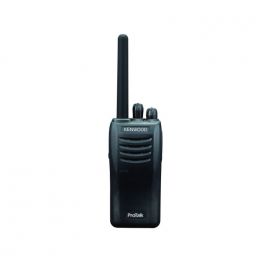
Ref: KW3501
Our selection of long range two way radios (licensed)
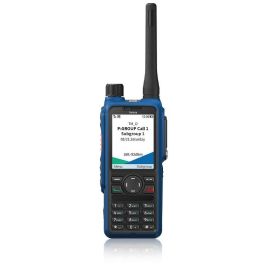
Ref: HYTHPD795EX
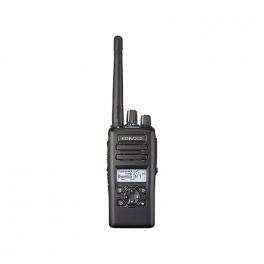
Ref: KWNX3320E2F8L7ML
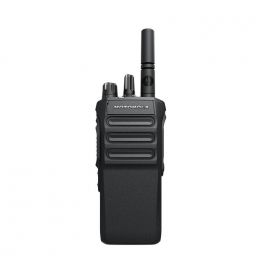
Ref: MOR7PNPVHF
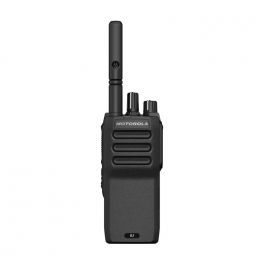
Ref: MOR2VHF
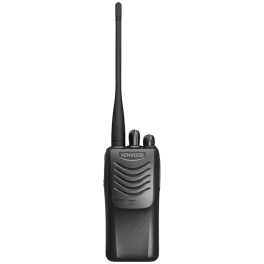
Ref: KW3000EUK
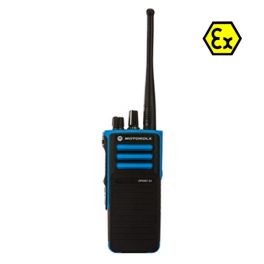
Ref: MODP4401VATEX
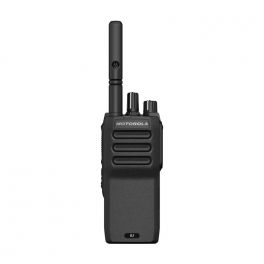
Ref: MOR2DVHF

Quiz: Find Your Model
Find the perfect walkie-talkie in a few questions
Form