
My Cart



Top 6 – Best Two-way radios for Hunting 2026
When you’re out hunting or navigating challenging terrain, clear communication is essential – and it needs to be well organised. A two-way radio is a real all-rounder: it keeps everyone in the team connected reliably, quickly and with minimal effort – simply over radio, with no hassle.
But with so many options available – range, frequencies, durability, plus brands like Motorola, Midland, Hytera and Kenwood – it’s easy to wonder: which device is actually right for me? If that’s exactly what you’re asking yourself, our guide is here to help. Here are the 6 best walkie-talkies for hunting compared:
IconTOP 6 Icon Comparison table IconFAQ
Our winning trio
Number 1
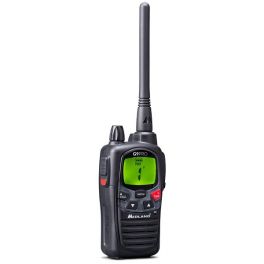
Range up to 12 km, ideal for outdoor use.
Long Battery Life
Rain and dust resistant.
Number 2
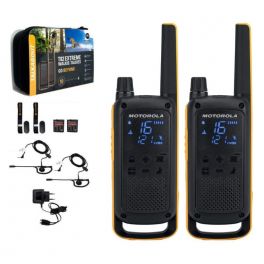
Motorola Talkabout T82 Extreme (EU Version)
4.2 of 159 Reviews
IN STOCK
Up to 10 km, perfect for outdoor activities.
IPx4-rated for use in tough conditions.
Comes with accessories like clips and earpieces.
Number 3
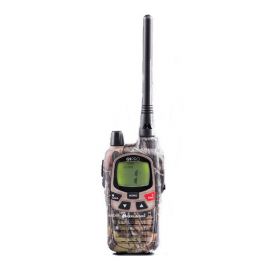
Covers up to 12 km for outdoor and professional use.
Built to withstand rain and dust.
Offers quick access to safety communication.
Our complete ranking:
Best overall package
The Midland G9 Pro Walkie-Talkie is a durable, weatherproof radio with dual-band support and a long range. It’s perfect for outdoor and professional use, offering reliable communication in tough conditions.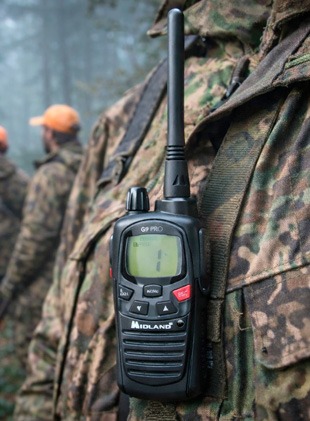
Features
AA Ni-MH Battery
32 PMR446 (16+16 pre-programmed) + 69 LPD
License-free
IPx5
Pros
Range up to 12 km, ideal for outdoor use.
Long Battery Life
Rain and dust resistant.
Cons
Larger size than compact models.
Lacks advanced options like Bluetooth.
Best all-terrain set
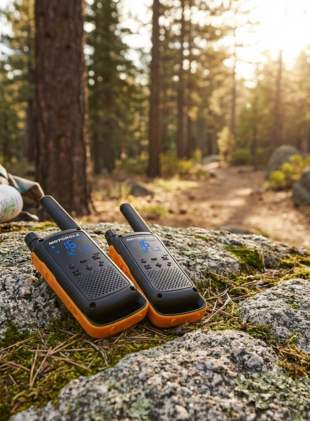
The Motorola T82 Extreme Walkie-Talkie is a durable, weatherproof two-way radio with a 10 km range and emergency features. It’s an excellent choice for outdoor adventures and rugged environments. By Sector
Manufacturing
Construction
Retail
Transportation & logistics
Hotels and restaurants
Public administrations
Education
Features
AA Ni-MH Battery
16 channels; 121 codes
License-free
IPx4
Pros
Up to 10 km, perfect for outdoor activities.
IPx4-rated for use in tough conditions.
Comes with accessories like clips and earpieces.
Cons
Lacks Bluetooth or GPS functionality.
May be tricky to use with gloves.
Best visual camouflage
The Midland G9 Pro Mimetic Walkie-Talkie combines a long communication range with a rugged, camouflage design. Weather-resistant and dual-band capable, it’s perfect for outdoor enthusiasts and professionals alike.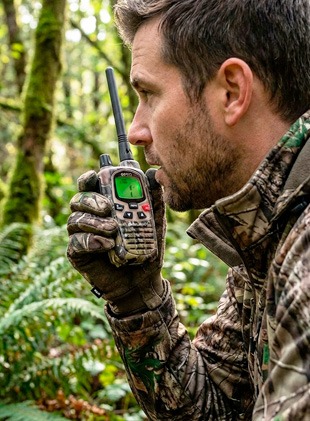
Features
AA Ni-MH Battery
Channels: 16 + 16
License-free
IPx5
Pros
Covers up to 12 km for outdoor and professional use.
Built to withstand rain and dust.
Offers quick access to safety communication.
Cons
Larger size might not suit all users.
Requires separate purchase for rechargeable packs.
Best licence-free digital walkie-talkie
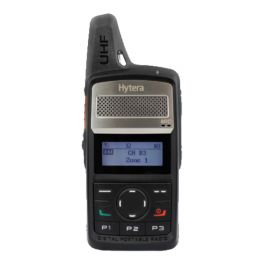
Let's continue with an unlicensed device that fits in your pocket: the Hytera PD365LF! It’s what we call a hybrid model: it supports both analogue and digital communications! Equipped with a 2000mAh Li-Ion battery, its battery life can last up to 12 hours of digital use in a 5-5-90 cycle. It’s perfect for long hunting days!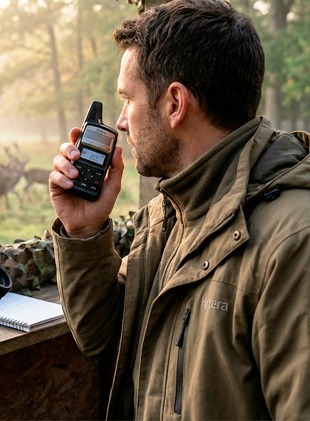
Features
Lithium-Ion batteries
Channels: 32
License-free
IP54
Pros
12h battery life in digital mode
Ideal size, designed to fit in your pocket
Dual mode: analogue and digital
Cons
No emergency call button
Non-waterproof: IP54 protection
Best for team coordination
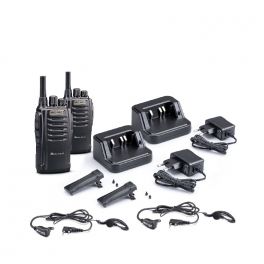
The Midland BR02 PRO Z Twin Pack offers reliable, easy-to-use walkie-talkies with a durable build and long battery life. Ideal for teams needing simple and effective communication tools in challenging environments.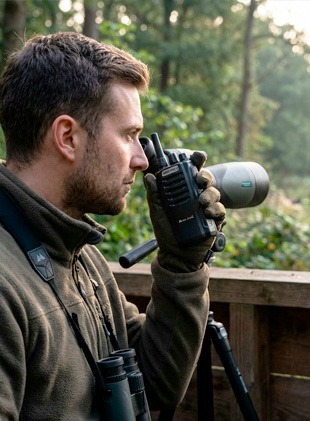
Features
Lithium-Ion batteries
Channels: 16 + 16
License-free
Pros
Lightweight and easy to carry.
Includes two radios, perfect for team use.
Simple controls for quick setup and use.
Cons
Lacks GPS, Bluetooth, or emergency alerts.
May not cover long distances like higher-end models.
Best combination of discretion and simplicity
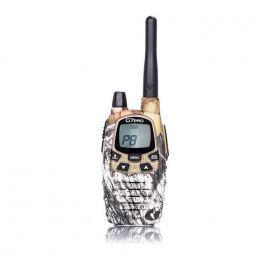
The Midland G7 Pro Camo Walkie-Talkie features a rugged camo design, dual-band functionality, and long battery life, making it an excellent choice for outdoor enthusiasts and professionals in tough conditions.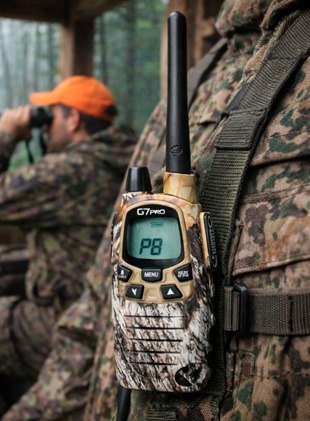
Features
AA Ni-MH Battery
Channels: 8 - 38 - 121
License-free
Pros
Ideal for outdoor and tactical use.
Provides quick access to safety communications.
Long battery life
Cons
Less compact compared to lightweight models.
Rechargeable packs sold separately.
| 1 | 2 | 3 | 4 | 5 | 6 | |
| ATEX certified | Without ATEX certification | Without ATEX certification | Without ATEX certification | Without ATEX certification | Without ATEX certification | Without ATEX certification |
| Channels - Sub-channels - Codes | 32 PMR446 (16+16 pre-programmed) + 69 LPD | 16 channels; 121 codes | Channels: 16 + 16 | Channels: 32 | Channels: 16 + 16 | Channels: 8 - 38 - 121 |
| Frequency | License-free | License-free | License-free | License-free | License-free | License-free |
| IP Rating | IPx5 | IPx4 | IPx5 | IP54 | ||
| Military standard | Not confirmed to military standard | Not confirmed to military standard | Not confirmed to military standard | Confirmed to military standard | Not confirmed to military standard | Not confirmed to military standard |
| Range | 10km | Jusqu'à 12 km | 10 km | 10 km | ||
| SOS button | With SOS button | With SOS button | With SOS button | Without SOS button | Without SOS button | Without SOS button |
| Voice encryption function | Without voice encryption | Without voice encryption | Without voice encryption | Without voice encryption | Without voice encryption | Without voice encryption |
| VOX/iVOX hands free | With earpiece | With earpiece | With earpiece | With earpiece | With earpiece | Without earpiece |
FAQ – FREQUENTLY ASKED QUESTIONS
Why choose a walkie-talkie for hunting?
- Free communication: Most models in our ranking allow free communication within a range of up to 10 km. What’s more, all licence-free radios are compatible with each other.
- Durability: With IP certification, they are protected against environmental elements (dust, water, etc.) as well as everyday impacts (knocks, drops, etc.).
- Voice activation: This is the VOX function. In short, the device automatically transmits when it detects your voice, as soon as an audio accessory is connected.
- Safety: In case of an emergency, the emergency call button allows you to alert other radios within a range of several kilometres.
Should I choose a licensed or licence-free model?
As you may know, walkie-talkies fall into two categories: licence-free models and licensed devices. What’s the difference? It’s quite simple:
- Licence-free: As the name suggests, these devices operate on PMR446 frequencies, allowing free and open communication with others. Note: channels are not private.
- Licensed: These are typically aimed at professional users. Why? Because they offer secure communications through private channels. To obtain a licence, you must apply through the relevant regulatory authority. Contact us – we’ll be happy to help you through the process!
Which type of two-way radio is best?
This isn’t about a specific brand or model, but rather the characteristics of each type of walkie-talkie. There are three main types:
- Analogue: They operate on a single channel, which can lead to interference. PMR446 models include sub-channels for multiple conversations.
- Digital: Designed to gradually replace analogue models, they offer significantly better performance, closer to that of mobile phones.
- Hybrid: These combine the technologies of analogue and digital models, making them ideal for a smooth transition to digital systems.
What does the IP rating mean?
The “IPXX” rating appears on many products – but what does it mean? It’s a code that indicates the level of protection against dust and water:
- 1st digit: Protection against solid particles (e.g. dust)
- 2nd digit: Resistance to moisture and water
It’s simple: the higher the number, the better the protection. Want to learn more about IP ratings? Take a look at our dedicated page