
My Cart



Bluetooth VS DECT: Which option should you choose for your headset?
When choosing a wireless headset, you’ll need to pick a connection type: Bluetooth or DECT.
It’s easy to assume they’re the same, but they actually have important differences! We’re here to make sense of these options, breaking down the details so you’ll know exactly which is best for you. Keep reading to learn all about Bluetooth and DECT!
Not sure what you need?
After the basics…

Bluetooth
#headphones #bluetooth
You probably already know what Bluetooth is, but we'd like to give you a quick refresher (just in case) ... Basically, it's a wireless technology that allows you to connect devices together and transfer data over short distances.
ITS ADVANTAGES
Icon Versatility galore: Headsets, watches, computer peripherals, …(the list is long)Bluetooth is present almost everywhere ( and makes our lives easier ).
Icon Mobility: With an average range of 10 meters, Bluetooth is your golden ticket to experiencing the freedom of wireless life (music and calls) !
Icon Easy as pie: No need to be a computer pro. It's Plug & Play 2.0: activate the mode on your devices and watch the magic happen!
ITS DISADVANTAGES
Icon Shy range: You can move, but not too much! Beyond 10 meters, you risk losing the connection (and your interlocutor if you are on a call)
Icon Surprise interference: Shared frequency bands mean risks of friction… In crowded areas, your connection crackles and loses performance!
Let's start with the basics: DECT stands for Digital Enhanced Cordless Telephony, in concrete terms, it is a wireless standard used to connect audio accessories to a desk phone or softphone via a base station or dongle. It relies on clean frequency bands (1880–1900MHz in Europe) to transmit data: it does not interfere with other technologies such as Wi-Fi and Bluetooth.
ITS ADVANTAGES
Icon Crystal clear sound: With DECT, no more calls that sound like Morse code... The audio quality is such that you feel like the person you're talking to is right next to you.
Icon Extended range: 55-180m (headsets) and 50-300m (phones), this allows you to walk around the company without losing track of the call.
Icon Guaranteed reliability: No jamming on the horizon! DECT uses reserved frequencies, which reduces interference and ensures stable communication.
ITS DISADVANTAGES
Icon Not very versatile: It is dedicated body and soul to voice calls, and therefore cannot be found on all types of devices like Bluetooth...
Icon Cost: High quality means high price... DECT devices can be more expensive, especially because of their dedication to voice communications.

DECT
#headset #dect
Let's compare...
Connectivity
IconTop criteria
 Bluetooth: If there's one that rhymes with versatility, it's this one! Just think: a Bluetooth headset can memorize up to 8 separate devices. In short, you can use several communication tools and change them quickly!
DECT: Conversely, DECT rhymes with exclusivity! Yes, a DECT headset is designed to be paired with only one device at a time. We recommend it especially if you don't need to change communication devices frequently!
Pairing conditions
Bluetooth: The Bluetooth headset remains the best option in terms of simplicity! To connect 2 devices, the only conditions to meet are: check that they are Bluetooth compatible and activate Bluetooth mode on each of them!
DECT: Conversely, the DECT headset is dependent on its base station/dongle (which provides connection to the telephone network). Pairing is therefore done in 2 stages: the base station is first connected to the telephone line via a physical cable, and then it is the DECT which makes the wireless connection between the devices!
Scope
Bluetooth: It still has a lot of progress to make... Located between 10 and 100 meters, it depends mainly on the class of the device:- Class 1: approximately 100 meters
- Class 2: approximately 10 meters
- Class 3: approximately 1 meter
- Class 2: approximately 10 meters
- Class 3: approximately 1 meter
Good to know: classes 1 and 2 are the most common (mobiles and headsets). Class 3 is rather reserved for devices such as keyboards and mice.
DECT: It really goes all out on this point! Generally, between 55 and 180 meters indoors, it has the advantage of being able to be extended using wireless repeaters. However, in dense areas (call center), it is subject to interference. To minimize them, 2 options:
- Adjust the configuration: make sure the bases are far enough apart
- Reduce the DECT range to 20 meters
- Reduce the DECT range to 20 meters
Note: The actual range of Bluetooth and DECT depends on their usage environment (indoor or outdoor) and the type of obstacles separating the devices.
Density
IconTop criteria
Glossary minute: When we talk about density, we are referring to the number of devices in proximity that can be used at the same time without interference.
Bluetooth: By operating on open frequencies, it shares the stage with other technologies, such as Wi-Fi. Quite often, Bluetooth headsets encounter interference with other devices tuned to the same 2.4GHz frequency (TV, printer, etc.)
DECT: By using their own frequency range, DECT devices can accommodate and manage much higher user densities. On the other hand, the question of interference problems does not even arise for them, again thanks to their dedicated band!
Security
IconTop criteria
Bluetooth: Device pairing is done over the air; bandwidth transmission is done using FHSS technology and encryption is done using an 8-128 bit key. In short, Bluetooth, although increasingly secure, is still below DECT and its AES encryption!
DECT: It works via a 3-level security chain.
- The headset is first paired to a base station via an authenticated DECT connection (DSAA).
- Then, the security links are checked to ensure that the call is made between 2 authorized devices.
- Finally, the voice data is encrypted via 64-bit AES encryption and transformed into digital data.
- Then, the security links are checked to ensure that the call is made between 2 authorized devices.
- Finally, the voice data is encrypted via 64-bit AES encryption and transformed into digital data.
To sum up, this process makes hacking almost impossible!
Sound quality
Bluetooth: It is well known that Bluetooth devices are sensitive to external interference... So, when using a headset of this type, you must keep in mind that you may be confronted with it at one time or another, and therefore experience a temporary drop in the quality of your communications.
DECT: The fact that it is exclusively dedicated to telecommunications gives a major advantage to the DECT headset. Which one do you ask? Well, it delivers a drastically more stable and clearer call quality!The models most requested by our customers

BLUETOOTH
Today, there is classic Bluetooth and multipoint! The difference? With the 2nd, you can connect your headset to several separate devices and juggle between them!
Example: you can connect it to your PC and your mobile at the same time and take calls from both devices!
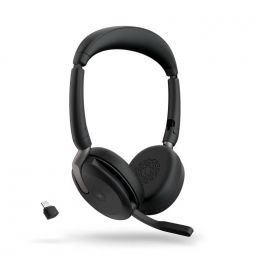
Ref: GNEVOL265FDCM
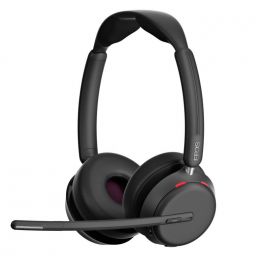
Ref: SEIMP1060T

DECT
Connecting a DECT device to a PC is not done directly, it goes through a base station!
Good to know: one station can power multiple devices, so you don't lose out in terms of practicality!
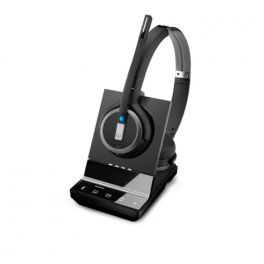
Ref: SESDW5066V2
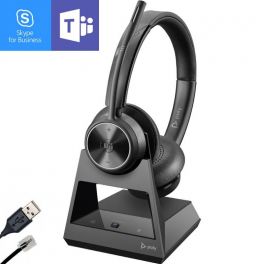
Ref: PLW7320OCDM
So, Bluetooth or DECT?
We have to admit: there is no clear winner at the end of this comparison… Ultimately, the choice between Bluetooth and DECT will largely depend on the specific needs of your professional situation. To help you see things more clearly, we have made a brief summary of the 2 technologies:
| BLUETOOTH | DECT | |
| MAX NUMBER OF CONNECTIONS | 8 | 1 |
| SOUND QUALITY | Interference dependent | Rich and stable |
| PAIRING CONDITIONS |
Bluetooth mode enabled |
DECT mode activated |
| WIRELESS RANGE (INDOOR) |
Between 10 and 100 meters |
Between 55 and 180 meters |
| SECURITY |
Frequency change |
3-level safety chain |
| APPLICATION SCENARIOS |
Any other Bluetooth device |
Voice communications |
| DENSITY |
Small number of users |
Large number of users |
Our recommendation:
Making the right decision means first and majorly looking at your professional profile and your daily requirements:
Office or call center employee: DECT, an obvious choice!If you work in a fixed location and use only one desk phone or softphone, then you are eligible for the DECT headset! Highly secure, this standard protects your calls and allows you to move around without losing your connection on the way… In addition, the call quality is much better on the audio side!
Hybrid worker or on the go: Bluetooth is made for you!
If you need to switch easily between your computer, tablet, mobile etc, then Bluetooth is the best option! Plus, it doesn't need a base station to work! In practice, its limited range won't be a problem as you'll never stray too far during calls.
Find the perfect headset in just a few clicks
Not sure what you need?
Answer these few questions and one of our sales representatives can help you make your project a reality!